
An invite-only dating app limits who can join. You get in through a referral code, a member's endorsement, or an application that the service reviews by hand. Some also add a waitlist and a paid membership after approval. If you want a smaller, more filtered crowd, this guide covers how access works, what the screening looks at, what it costs and what to check before you hand over personal details. It also covers what to do if you would rather skip the waiting.
TL;DR
- Invite-only means access is gated by a referral, an endorsement or a manual application review, not just a download and an email address.
- Screening can include identity checks, work or social-profile verification and, at a few services, income documents. Requirements differ by service and country.
- Membership often costs real money. One well-known invite tier was reported at $499 a month, so read renewal and cancellation terms first.
- Smaller pools can feel more curated, but fewer members can also mean fewer people near you.
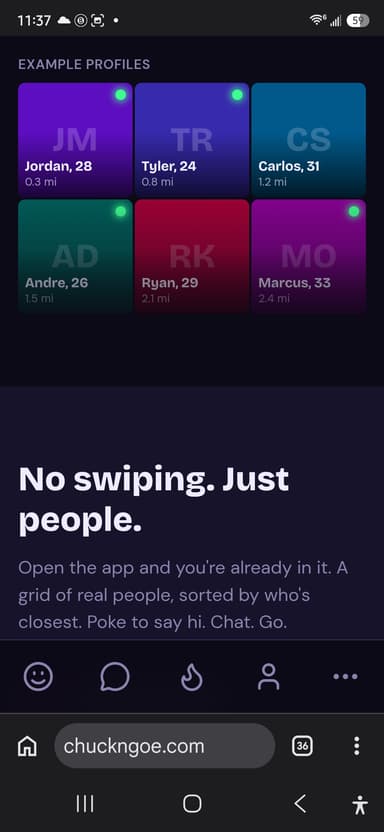
- If you want adults-only and no waitlist, ChuckNGoe confirms age at sign-up and lets you see and chat with people nearby right away.
Table of Contents
- What "invite-only" actually means
- How people get invited or apply
- What screening usually looks at
- How long approval takes and what a decline means
- What membership costs
- Benefits and trade-offs of a gated crowd
- Privacy and safety checks before you join
- Our perspective
- If you want adults-only without the wait
- How the two approaches compare
- Making a good first impression, wherever you sign up
- FAQ
- Sources
What "invite-only" actually means
Ordinary dating apps let anyone with a phone create a profile. Invite-only apps put a gate in front of that profile. The gate can take a few forms:
- A referral or invite code from an existing member.
- An application that a team reviews before granting access.
- A waitlist that releases spots as the service decides it has capacity.
These are different from paid membership. A paid app lets anyone in who pays. An invite-only app decides first, and money may come second. Reporting on one premium tier from a major swipe app described it as costing $499 a month and requiring both an invitation and an application. The invitation and the fee were two separate hurdles.
Another long-running example works as a pipeline: you sign up, join a waitlist and then have your application manually reviewed, with access depending on approval. Approval, not payment, is the first checkpoint.
The common promise behind all of it is a more filtered pool. Whether that promise holds depends on who is doing the filtering and what they filter for.
How people get invited or apply
There is no single route. Most services use one or more of these.
A referral from a member
An invite can be a code or a personal endorsement from someone already inside. InsideHook's 2022 overview describes invites as referral codes or endorsements, and applications as something that may ask for identity, social-profile or professional information.

If you know a member, ask whether they have invites to share. Some services give members a limited number, so a friend may not always have one to spare. Check the app's own help pages for how its referral system works.
A direct application
Some services let you apply without a referral, but the odds can be lower. The same InsideHook piece reported that applicants to one creative-community app could apply without a referral but were warned that very few people were accepted that way. Treat that as one service's stated policy, not a rule for every app.
A typical application asks for some mix of:
- A few clear, recent photos
- Your age and location
- A short bio or answers to prompts
- Links to a social or professional profile
- Sometimes a phone number or work email for verification
The waitlist
Waitlists exist because the service wants to control the balance of its membership. Hindustan Times reported in November 2025 that applicants to one India-focused model who lacked an immediate endorsement could stay waitlisted until an endorsement came through or capacity opened up. That describes one market and one service, but the logic is common: your place may depend on who you know and who else is applying in your area.
What screening usually looks at
Screening varies a lot, and some of it is intrusive. Knowing the range helps you decide what you are comfortable providing.
| Check | What it involves | Example from reporting |
|---|---|---|
| Work or social verification | Official work email or a professional or social profile | The India-focused League-style model used official email or LinkedIn verification, plus member endorsement (Hindustan Times) |
| Location and profile checks | Confirming where you live and linking existing accounts | InsideHook described location and Facebook or LinkedIn verification requirements for one app (InsideHook) |
| Government ID and selfie | Identity document check and a live photo | One India-focused service used Aadhaar-based KYC and a live-selfie check (Hindustan Times) |
| Income documents | Salary slips, tax returns or offer letters | The same service asked men meeting its stated income threshold for these documents |
Those last two rows are country- and service-specific. They are not worldwide standards, and you should not assume a U.S. service will ask for the same things.
A fair rule: the more sensitive the document, the more clearly the service should explain why it needs it, who sees it and how long it keeps it. France's data protection authority advises users to check whether sensitive documents requested by selective clubs are actually necessary. That advice applies anywhere.
How long approval takes and what a decline means
No reliable, service-independent timeline exists. Approval can be fast for referred applicants and slow for everyone else, and a waitlist can sit for as long as the service needs it to. Check the service's own application page for its current process, because these policies change.
If you are declined or waitlisted, a few practical points hold up:
- Look for a reapply policy. Some services state whether and when you can try again. If none is stated, ask support before submitting a second application.
- Get a referral. A member's endorsement is the route reporting most often mentions for moving past a waitlist.
- Keep your data in mind. A declined application still means you handed over information. Ask how it is stored and whether it can be deleted.
- Have a backup. Waiting for an invite is a reason to keep meeting people some other way, not a reason to pause.
What membership costs
Getting in is often only the start. Prices tend to be high because the fee is part of the filter.
- The premium tier mentioned above was reported at $499 per month.
- A League-style service lets approved members subscribe for access to its network, capped daily matches and in-person events, according to Hindustan Times. The same report said one India-focused service's plans start from 50K to 5L, in rupees.
- A South African service launched in 2026 with invite-only access and vetting, at R488 per month for full access and R188 per month for guest access.
Those figures are specific to each service and market, so do not treat them as U.S. prices. What they show is the pattern: approval, then a subscription, sometimes with limits on daily matches and optional events.
Before paying, read the terms. The UK government's online dating guidance tells users to check subscription cost and length, how a trial converts, renewal terms, and cancellation and refund rules. It is UK guidance, but the questions are sensible for any subscription.
Benefits and trade-offs of a gated crowd
The appeal is easy to see. A vetted pool can feel calmer, with fewer fake accounts and people who took the process seriously enough to apply. Capped daily matches can slow things down for people tired of endless scrolling.
The trade-off is density. A 2024 analysis from Dating Industry Insights argued that invite-only access and capped match volume can create early exclusivity while reducing the user density and network effects that make discovery useful, especially once location, age and preferences narrow the pool. In plain terms, a small crowd is only helpful if enough of it lives near you and wants what you want.
So ask these before applying:
- Are there members in my city, or only in a few big metros?
- Will I be matched, or can I choose whom to talk to?
- Does the fee buy something I would use, like events or more visibility?
- Am I comfortable with the information requested?
Privacy and safety checks before you join
Any app that asks for identity, work or social details deserves a careful read. France's CNIL recommends checking the privacy policy and terms, who receives your data and for what purpose, how to exercise your rights, ad consent, profile visibility and app permissions, and limiting the personal information you share.
A short checklist:
- Read what the app collects and why before you upload any ID.
- Turn off permissions the app does not need.
- Find the block and report tools before you chat.
- Check whether your profile is shared with other sites, as the GOV.UK guidance advises.
- Meet first in a public place and tell someone where you are going.
Our perspective
We built ChuckNGoe on a simple idea: the hard part of meeting someone shouldn't be getting through the door.
Gated apps solve a real worry, which is wanting a crowd that takes things seriously. We think there are other ways to get there. ChuckNGoe confirms age at sign-up so the space stays adults-only. You get block and report controls you manage yourself. You also decide how your location is shown, because privacy shouldn't depend on an application.
Then we remove the waiting. You see the profiles of people around you right away. You can poke or chat with anyone, with no matching step and no swiping. Our design aims at real conversation between adults who happen to be nearby, not at a queue.
If your goal is to meet people in your area this week, we think an open, age-verified, location-first app serves you better than a waitlist.
Tom
If you want adults-only without the wait
Some people want a filtered crowd. Others want a safe, adult space they can use today. ChuckNGoe is built for the second group. Sign-up is simple, age is confirmed at the start, and you can see who is around you in real time.
The free plan lets you browse, poke and chat with no published price. Join ChuckNGoe free to see who is nearby.

If you want more room, ChuckNGoe Pro is $20.00 per month or $200.00 per year on the pricing page. Pro adds full grid access, an ad-free experience, group chat initiation, unlimited private albums, read receipts and advanced filters.
How the two approaches compare
| Typical invite-only app | ChuckNGoe | |
|---|---|---|
| Getting in | Referral, application or waitlist | Simple sign-up with age confirmation |
| Starting a conversation | Often through matches | Poke or chat with anyone, no matching |
| Swiping | Varies by service | None |
| Location | Varies | You manage how your location is shared |
| Safety tools | Varies by service | Block, report and age verification |
| Cost | Subscription after approval, sometimes high | Free to use; Pro is $20.00 per month or $200.00 per year |
The left column reflects the patterns described in the reporting above, not any one service. The right column describes what ChuckNGoe offers.
Making a good first impression, wherever you sign up
Whether you apply to a gated service or join an open one, the same habits help.
- Use clear, recent photos. Reviewers and nearby members both respond to faces they can see.
- Write a short, specific bio. One concrete detail about what you like beats a list of adjectives.
- Keep personal details minimal. Skip your home address, workplace specifics and financial information.
- Start with a simple, friendly message. A direct question about something in their profile works better than a generic greeting.
- Use block and report early. If someone makes you uncomfortable, you don't owe them a reply.
FAQ
Is ChuckNGoe invite-only?
No. You can sign up without a code, referral or waitlist. We confirm age at sign-up to keep the app adults-only, and you can start with the free plan.
Can I get into an invite-only dating app without knowing a member?
Sometimes. Some services accept applications without a referral, but reporting has noted that very few people were accepted that way at one of them. A member's endorsement is usually the stronger route, and the service's own application page has the current rules.
Are invite-only dating apps safer?
Not automatically. Screening can reduce fake accounts, but safety depends on the service's reporting tools, how it handles your data and your own habits. Check the privacy policy, limit what you share and meet in public places.
How much do invite-only dating apps cost?
It depends on the service and country. One premium tier was reported at $499 per month, while a South African service listed R488 per month for full access. Always read the renewal and cancellation terms before paying.
Sources
- Tinder expands offering of invite-only $499 monthly membership (CNN, 2023)
- Invite-only dating and its cultural history (Medialities, 2021)
- What are invite-only dating apps? (Hindustan Times, 2025)
- How Do You Gain Access to the Most Elite Dating Apps? (InsideHook, 2022)
- MirrorMe launches as invite-only safe dating app in South Africa (Global Dating Insights, 2026)
- Sites et applications de rencontres : comment protéger votre intimité (CNIL, 2025)
- Online dating: what to look out for (GOV.UK, 2018)
- Dating Industry Insights analysis (2024)